Product descriptions at scale become a three-week writing job when every item is treated as a separate piece. Four hundred product descriptions Almost nobody has three weeks, so what usually happens instead is that the first forty are excellent, the next hundred are fine, and the remaining two hundred and sixty are the supplier’s copy with the brand name swapped.
The problem is not stamina. It is that the job was framed as writing when most of it is assembly.
Product descriptions at scale start with triage
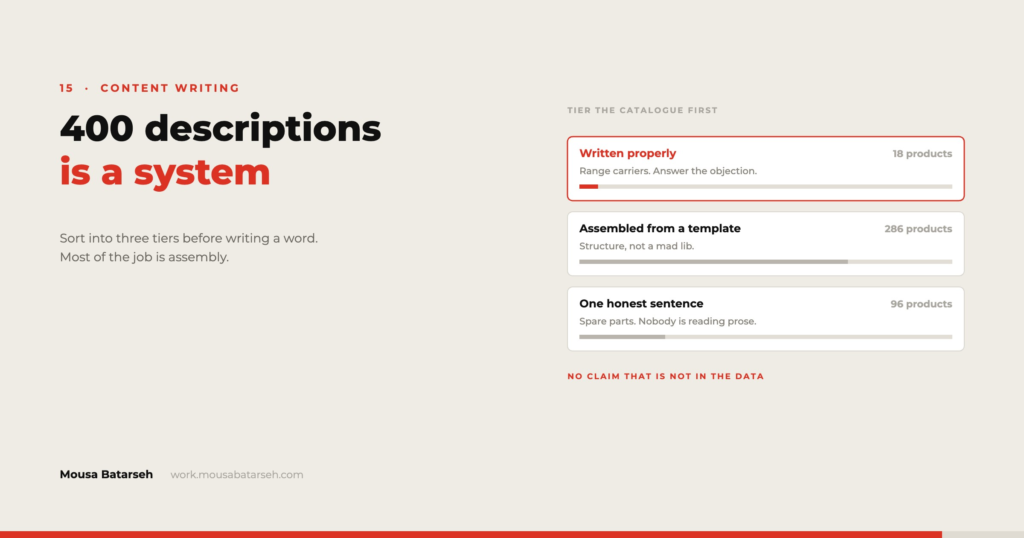
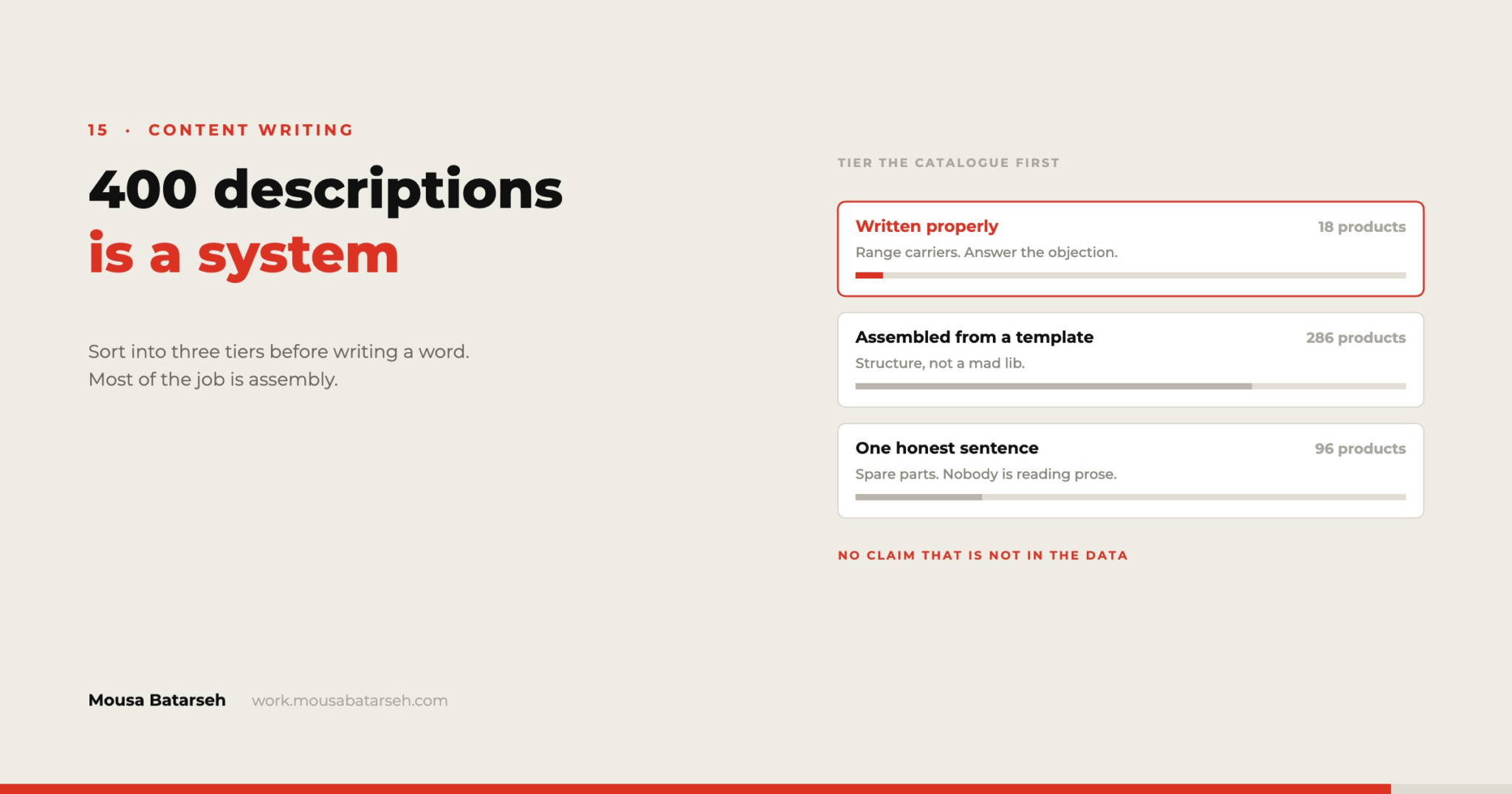
The first pass is not writing at all, it is triage — the same three-tier split I use for on-page SEO at scale, because the two jobs are really the same job.
A small tier gets written properly: the products that carry the range, the ones people search for by name, the ones with a margin worth defending. A large middle tier gets assembled from a template with real attribute data. A third tier gets a single honest sentence and nothing more, because the product is a spare part and nobody is reading prose about it.
Getting the proportions right is the whole game. If the top tier is more than about one product in twenty, the work will not finish. If it is empty, the catalogue reads like a database and nothing distinguishes it from every competitor selling the same items.
Templates for product descriptions at scale
Templated copy fails when the template is a sentence with holes in it. “This [colour] [product] is made from [material]” produces four hundred identical sentences, and identical sentences are worse than no sentences — they read as automated, which makes the whole store feel automated.
What works is a template of structure rather than words: a first line that states what the thing is and who it is for, a short paragraph on the material or construction that varies with the attribute values, and a specification block that is genuinely tabular data rather than prose pretending to be data.
The variation then comes from the attributes being different rather than from the writing being different, and the specification block carries the information load without needing sentences at all. For a practical field checklist, compare the catalogue attributes with Google Merchant Center’s product data specification. Which is also why it works: people scanning a product page read the spec block first anyway.
Write the top tier from the objection, not the feature
For the products that get real writing, the useful question is not “what is it?” but “what makes someone hesitate?”
For workwear it is durability and sizing. For anything technical it is compatibility. For wholesale it is minimum quantities and lead time. The description that answers the hesitation converts; the description that lists features that are already visible in the spec block does not.
The source for those objections is not imagination. It is the emails the business already receives — the pre-sale questions, the returns reasons, the things a salesperson repeats on the phone every day. An hour spent reading support email is worth more than a day of keyword research for this particular task.
Guardrails for product descriptions at scale
- No claim that is not in the data. If the attribute is empty, the sentence does not appear. Templated copy that invents specifications is a returns problem waiting to happen.
- A minimum length, not a target. Enough to be useful; padding to hit a word count produces the filler everyone recognises.
- One template per category, never one per site. The structure that suits fabric does not suit fasteners.
- Spot-check twenty at random after generation, reading them as a customer rather than as their author. Awkward joins show up immediately and are usually one template fix, not twenty edits.
Handing it over so it survives
The catalogue keeps growing after the project ends, and whoever adds product 401 will follow whatever pattern is easiest to find.
So the deliverable is not four hundred descriptions. It is four hundred descriptions plus the templates, the tier definitions, and three worked examples per category showing a good one, an acceptable one, and one that would be rejected. Without that, the next hundred products drift back to supplier copy within a quarter and the investment quietly unwinds.
What this is really about
Product descriptions at scale are an editorial system, not a writing marathon. The decisions that matter — which products deserve real attention, what structure carries the information, what may never be claimed — are made once and then applied.
Treat it as writing and you get forty good pages and a lot of filler. Treat it as a system and the whole catalogue reads as though somebody cared, which is the actual goal.