Category structures fail in a specific way. They do not break; they bloat. A tree that was sensible at four hundred products becomes unusable at five thousand, and the symptom is always the same — a category page with eleven hundred items in it and no way to narrow them down.
The instinct at that point is to add more categories. That is usually the wrong move, and it is worth understanding why before restructuring anything.
Categories answer “what is it?” and nothing else
A category should describe what a product is. A t-shirt is a t-shirt. It is not a “summer essential,” it is not “under £20,” and it is not “navy.”
Those are all real things a customer might want, but they are properties of the product, not its identity. The moment they become categories, products start belonging to six of them, the tree stops being a tree, and nobody can answer where a new product goes without asking a colleague.
The test I use is whether a product can sit in exactly one place in the tree without anything feeling lost. If the answer is no, the thing being modelled is an attribute and it belongs in filters, not in the navigation.
Three levels is usually the limit
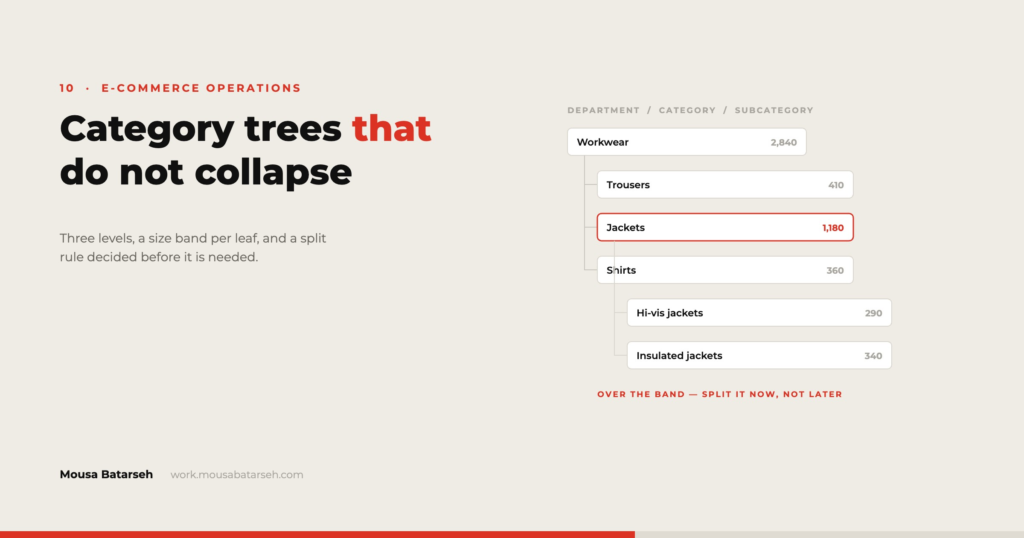
Department, category, subcategory. Beyond that, two things go wrong at once.
The customer loses their place — a fourth level means a breadcrumb that wraps and a menu that cannot be rendered sensibly on a phone. And the subcategories get thin: a level-four page with nine products in it is not a browsing experience, it is a dead end that also has to be maintained, described, and given a meta description.
If a three-level tree is not enough, the honest reading is usually that the catalogue is wide rather than deep, and the answer is filtering at level three rather than a fourth level of nesting.
The size rule that keeps it healthy
I hold each leaf category to a rough band: enough products to be worth visiting, few enough to be scannable. In practice that is somewhere between about fifteen and a few hundred, and the exact numbers matter less than watching the two failure modes.
- Under about ten products, the category is not pulling its weight. Merge it upward and let a filter do the work.
- Over a few hundred, the category has become a search results page with a nicer name. Split it, or accept that filters are now doing the real navigation and design the page accordingly.
- Growing fast, and you should decide now how it will split later, while the decision is cheap and reversible.
The band is a maintenance signal more than a design rule. Categories drift out of it as the catalogue changes, and reviewing the counts twice a year catches structural problems long before a customer complains.
Plan the split before you need it
Every catalogue has categories that will outgrow themselves — the ones tied to whatever the business is expanding into. Deciding the split rule early is much cheaper than deciding it under pressure.
The rule matters because it determines the URLs. Splitting by product type keeps URLs stable when the range grows. Splitting by brand does not, because brands come and go and taking a brand off the shelf then orphans a URL that used to rank. Splitting by price is the worst of the three: prices change, and the structure of the site should not move when they do.
When a split does happen, it is a redirect exercise, and it deserves the same care as a full migration. One old URL, one new URL, decided by a person.
Naming for people who are not you
Category names get written by whoever knows the products best, which is exactly the wrong instinct. Internal names and trade names feel precise and read as jargon.
The name should be the words a customer would use unprompted — which is usually the plainest available option, and often the one that looks disappointingly obvious on a whiteboard. “Work trousers” beats “occupational legwear.” Search Console is the honest source here: it tells you the language people actually arrived with, which is rarely the language on the shelf label.
What this is really about
A category tree is a promise that the site can be browsed rather than only searched. Browsing is how people shop when they do not know exactly what they want, which on most stores is most people most of the time.
When the tree bloats, browsing quietly stops working and everything shifts to the search box — and search on an average store is not good enough to carry that load. The fix is almost never more categories. It is fewer, better-sized ones, with the properties moved into filters where they belonged in the first place.