Website migration redirects are the migration plan, not a launch-day cleanup task. Every replatforming project has a moment where somebody says “we will sort the redirects out at the end.” That sentence is how catalogues lose a third of their search traffic in a fortnight.
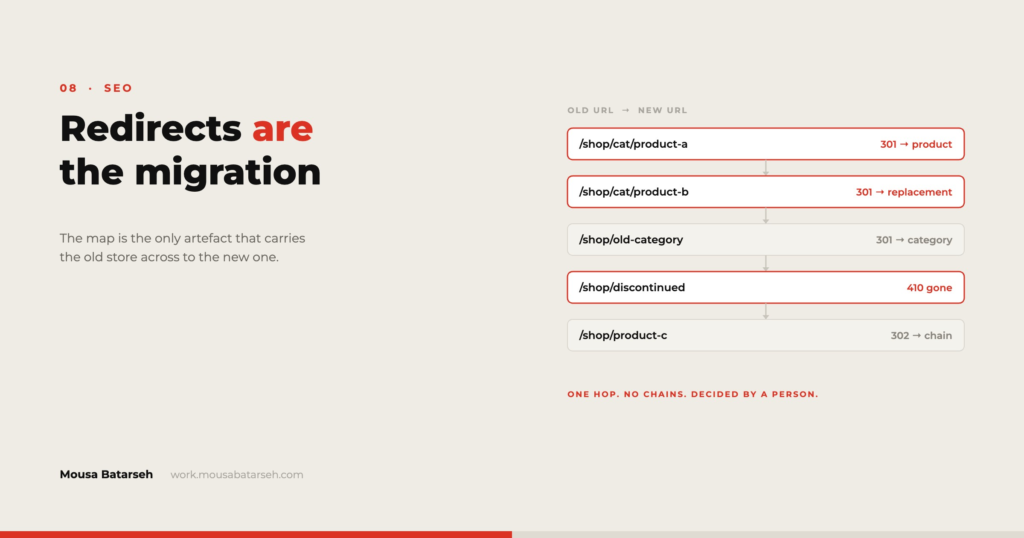
Redirects are not a cleanup task. On a store with more than a few hundred URLs, the redirect map is the migration — it is the only artefact that carries the value of the old site across to the new one. Everything else is just moving data around.
Website migration redirects: What actually breaks on launch day
The visible failure is a 404 page. That is the least of it, and the easiest to spot.
The expensive failures are quieter. A product page that redirects to the category instead of its replacement loses its ranking and looks, to a search engine, like the product no longer exists. A chain of three redirects loses a fraction of its signal at each hop and slows the page for anyone arriving from an old link. A redirect to a page that itself redirects to the homepage is functionally a 404 with better manners.
And there is the class of failure nobody notices for months: the old URL still resolves. Both versions are live, both are indexed, and the store is now competing with itself on every product it sells.
Testing website migration redirects
The map starts with a crawl of the current site — every URL that returns a 200, not just the ones in the sitemap. Sitemaps are aspirational. Crawls are factual.
Then I pull two more lists. Search Console gives every URL that has received an impression in the last sixteen months, which catches pages the crawl missed because nothing links to them any more. Analytics gives every URL with a session in the last year, which catches pages people reach from email, print, or an old bookmark.
The union of those three lists is the real inventory. It is always bigger than anyone expects, and the gap between it and the sitemap is usually where the surprises live.
One old URL, one new URL, no cleverness
Each row of the map gets a destination decided by a person, and the destination is the closest equivalent page — not the closest equivalent concept.
A discontinued product with a direct replacement goes to the replacement. A discontinued product with no replacement goes to its category, and that is a real loss you accept knowingly rather than a default you fell into. A category that split into three goes to whichever of the three inherited most of its products. A page that genuinely has no equivalent gets a 410, which tells search engines to stop asking rather than leaving them to guess.
The rule I hold to is that no more than a small minority of URLs should land on a category or the homepage. If half the map points at the homepage, the map has not been made — the work has just been deferred and relabelled.
Patterns first, exceptions second
On a fourteen-thousand-URL catalogue, nobody is mapping every row by hand, and nobody should.
Most of a catalogue moves in patterns. If the old structure was /shop/category/product and the new one is /products/product, one rule handles thousands of rows. Write the pattern rules first, apply them, then audit what is left over. What remains after the patterns is the genuinely interesting part — the renamed categories, the merged products, the pages someone built by hand in 2019 and never told anyone about.
The exceptions list is usually a few hundred rows on a large catalogue. That is a day of careful work, and it is the day that decides whether the migration was a success.
Verifying it, twice
- Before launch, run the full old-URL list against the staging site and check that every one returns a single 301 to a 200. Not a 302. Not a chain. One hop.
- On launch day, run it again against production, because the server configuration is not the same and something always differs.
- For the following month, watch the 404 log rather than the rankings. Rankings move slowly and for many reasons. A 404 log tells you within hours which URLs you forgot.
The month of 404 monitoring is the step people skip, and it is the cheapest insurance in the project. Old links keep arriving from places nobody catalogued — supplier sites, forum posts, a PDF a rep emailed out in 2022.
What this is really about
A redirect map is an inventory of everything the old site earned. Building it forces a conversation about what actually mattered on the old store, which is a conversation most migrations never have — they discuss the new design instead.
Done properly it is unglamorous and takes longer than the client expects. Done badly it is invisible for six weeks and then shows up as a revenue problem that gets blamed on the redesign. The same principle runs through on-page SEO at catalogue scale: decide deliberately where the effort goes, and write the decision down before anything is imported.
For implementation details, review Google Search Central’s guide to redirects.