Shopify vs WooCommerce decisions go wrong when the platform question gets asked badly. “Which is better, Shopify or WooCommerce?” has no answer, in the same way that “which is better, a van or an estate car?” has no answer.
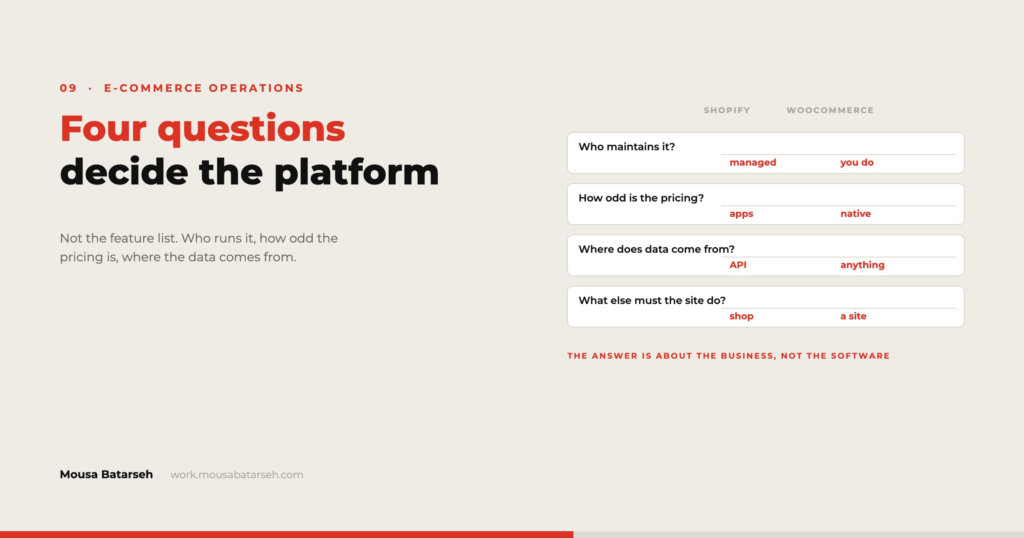
I have built and maintained both, on catalogues from a few hundred items to fourteen thousand. The decision has never once come down to features. It comes down to four questions about the business, and every one of them is about who will be running the store in eighteen months.
Shopify vs WooCommerce: who fixes it?
This is the first question and it settles more cases than the rest combined.
According to Shopify’s platform comparison, Shopify is a managed platform. Hosting, security patches, PCI compliance and uptime are somebody else’s problem, and that somebody has a support line. The cost of that is a ceiling: when you need behaviour the platform does not offer, you are working around it rather than through it.
WooCommerce is software you own and therefore software you maintain. Updates, backups, staging, plugin conflicts, and the hosting bill are all yours. The reward is that nothing is off limits — the database is right there and any behaviour can be built.
So the real question is whether the business has, or will pay for, somebody who owns that maintenance. Not somebody who could do it. Somebody whose job it is. If the honest answer is no, WooCommerce will decay into an out-of-date install with three broken plugins, and the platform will get blamed for a staffing decision.
Shopify vs WooCommerce pricing requirements
Retail pricing is simple and both platforms handle it without complaint. Wholesale pricing is where they separate.
If the business needs customer-specific price lists, quantity breaks that vary by account, tax handling that differs by customer type, or an approval step before an account can order, WooCommerce gets there faster and with fewer compromises. Those are all things the data model already supports and the ecosystem has solved repeatedly.
On Shopify the same requirements are reachable, but they tend to arrive as a stack of apps and some theme work, and each app is a recurring cost and a future upgrade risk. I built a wholesale storefront on Shopify and it works well — but the pricing logic was the part that needed the most deliberate design, not the catalogue.
How does product data get in and out?
Very few stores are the source of truth for their own products. The data usually lives in an ERP, a supplier feed, or a spreadsheet somebody maintains, and it has to arrive on a schedule.
The question is not whether a platform has an import tool — they both do. It is what happens on the third Tuesday when the supplier changes a column heading. Can you see the failure? Can you re-run one product rather than all of them? Can you diff what changed?
WooCommerce lets you write exactly the importer the situation needs, including the logging. Shopify gives you a good general importer and an API, and you accept its opinions about matching and updating. Neither is wrong. But if imports are weekly and the source data is messy, the ability to control the importer is worth more than most feature comparisons.
What does the roadmap look like?
- A store that will look much the same in three years is well served by Shopify. Predictable cost, minimal maintenance, no upgrade anxiety.
- A store that is one part of a larger site — content, tools, member areas, a growing set of landing pages — is usually easier on WooCommerce, because the shop is a component rather than the whole application.
- A store with a real integration list (ERP, warehouse, custom quoting) leans WooCommerce, because the integrations live in the same codebase rather than across an API boundary.
- A store with no technical owner leans Shopify regardless of anything else in this list.
The honest cost comparison
Shopify’s cost is visible: a subscription, transaction fees, app fees. It arrives monthly and nobody is surprised.
WooCommerce’s cost is real but scattered — hosting, premium plugins, and a number of hours per month that rarely appears on any invoice because it is absorbed by whoever keeps the site running. When people say WooCommerce is cheaper, they are usually comparing the subscription to the hosting bill and quietly omitting the hours.
Compare them properly and the gap narrows a lot. Which is the point: cost is rarely the deciding factor, and pretending it is usually means the decision was made on something else and dressed up afterwards.
What this is really about
Both platforms will sell products. The difference is what happens to the store in the years after launch, and that is determined by the business’s capacity, not the software’s feature list.
When a client asks me which to choose, I ask who is going to run it, how odd the pricing is, where the product data comes from, and what else the site has to do. By the fourth answer the choice is usually obvious, and it is obvious to them rather than to me — which is the only way it sticks.